In July, about 40 in every 100 Google searches on US desktop led to an unpaid result on another website. By September it was 46, the highest share in the 15 months Semrush tracked.
The desktop panel covers the US and 32 European countries, including the UK. Semrush State of Search Q3 2026
Key Takeaways
- In September, zero-click searches accounted for 22.99% of US Google desktop searches and 20.99% in Europe.
- In September, 43.14% of the European desktop panel visited ChatGPT at least once.
- The share of US Google searches over 15 words rose from 1.67% in August to 2.58% in September.
Google Retained Its Lead In Traditional Desktop Search
Of the five search engines Semrush tracked, Google accounted for 92.43% of US desktop searches and 94.47% in Europe in September. In August its US share had dipped to 87.38%. Even then, roughly nine in ten people in the US desktop panel visited Google during the month.
Across all US desktop webpage visits in Q3, 9.80% went to traditional search platforms and 1.27% to standalone AI tools. Writing an email in ChatGPT counts towards the second figure, as does looking something up.
Organic Click Share Recovered In September
I wrote in my Q2 State of Search analysis that external organic click share had dropped year on year in both regions in June. In Europe it was 40.72% in June and 49.56% in September.
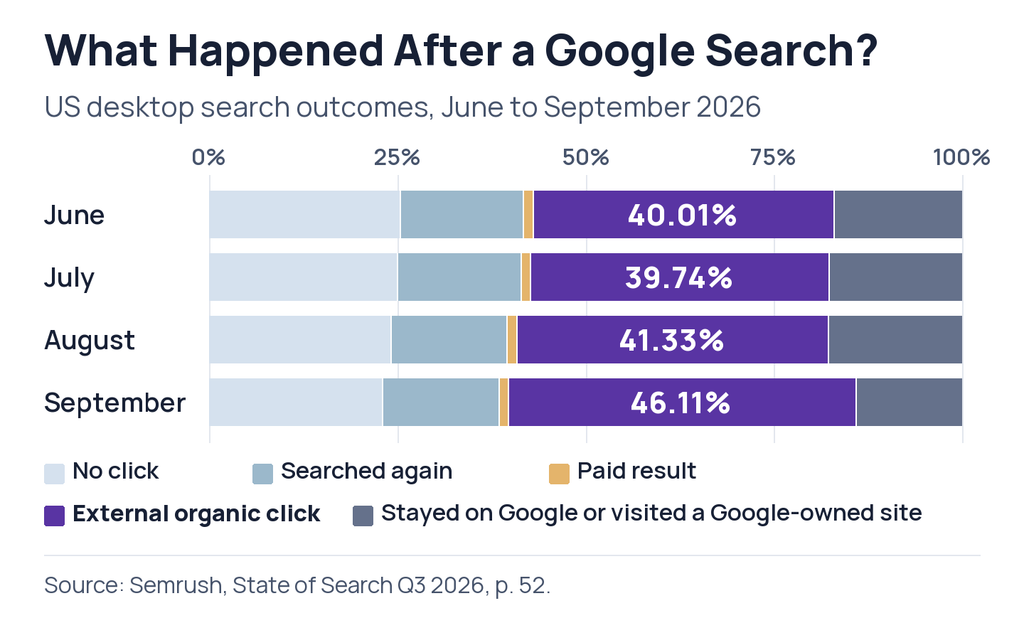
Semrush State of Search Q3 2026, page 52.
People who used Google in the US panel averaged about 123 searches each in July and 114 in September. If your clicks were down in September, I’d check impressions and average position on the queries you usually get traffic from. Losing a few spots for your best products looks much the same in a traffic report as fewer people searching for them.
AI Reach Grew Alongside Traditional Search
In June, 36.05% of US desktop panel users visited ChatGPT at least once. By September it was 38.56%. Over the year to September, standalone AI tools went from 0.72% to 1.29% of all US desktop webpage visits.
Google AI Mode went from 0.15% of US desktop webpage visits in July to 0.31% in September. In Europe it peaked at 0.53% in August, then slipped to 0.43% in September. Some AI search usage happens in the regular results too, where people can read an AI Overview and carry on with their search.
Google Queries Became Longer
In Europe, Google searches of more than 15 words reached 1.32% in September, four times their share a year earlier. Rand Fishkin’s read is that “people are treating Google search more like an AI assistant”.
One of the AI Mode conversations in our Australian automotive study went from an Everest and Prado comparison to seven seats and towing a trailer. Put the seating layout, towing limits and conditions for each grade in that comparison and you’ve saved someone opening two brochures.
Discovery Continued Across Shopping And Social Platforms
In September, US desktop users who searched Amazon averaged 17.62 searches each. In Europe they averaged 14.06. On LinkedIn, searches per US searcher went from 4.37 to 7.72 in the year to September.
Google and YouTube were the top two sites people visited immediately after using an AI tool in both regions.
What These Findings Mean For Australian Marketers
Of the 400 Australian car searches we checked in September, all 80 comparisons brought up an AI Overview. Among the 80 model searches, 42 did.
I’d put model pages and comparison pages on separate rows in the report, with Google clicks and test drive bookings for each. If the comparison pages gained impressions and lost clicks, I’d run a few of those searches on mobile and see which specs Google already gives people before they get to the site.
I’d use the same questions to check which brands get mentioned and which pages get cited. If three other utes come up because the answer has their towing limits and prices, I’d see how quickly I can find those figures for our own cars. For visits I can trace back to an AI tool, I’d check how many went on to book a test drive.
If you want help finding the pages worth working on, request an SEO growth plan.