Social search is not pulling people away from Google, rather it is adding stops on either side of it.
Six of the ten most-visited destinations straight after a US desktop search are social platforms.
TikTok and X posted record search engagement in the same quarter traditional search grew its share.
Last month I went through the Datos × SparkToro State of Search Q2 2026 report and made the case that AI search is not replacing Google. The social section of that report deserved more than the passing mention I gave it because it tells a similar story with a different cast. So here it is.
The hot takes you see likely on LinkedIn are that Gen Z searches TikTok instead of Google and the SERP is dying. Well…the clickstream data tells a less dramatic and more useful story. People are layering social search on top of organic search, much like they are with AI, and the journey can loop through both before anyone converts.
Social Platforms Are Search Engines Now
The Q2 numbers on search behaviour inside content platforms are the part of the report I keep coming back to.
In June 2026, the average US desktop user ran 12.3 searches on YouTube, 8.9 on X and 8.3 on TikTok. TikTok and X were both record highs in the Datos panel. LinkedIn reached 6.2 searches per user and has climbed steadily for a year.
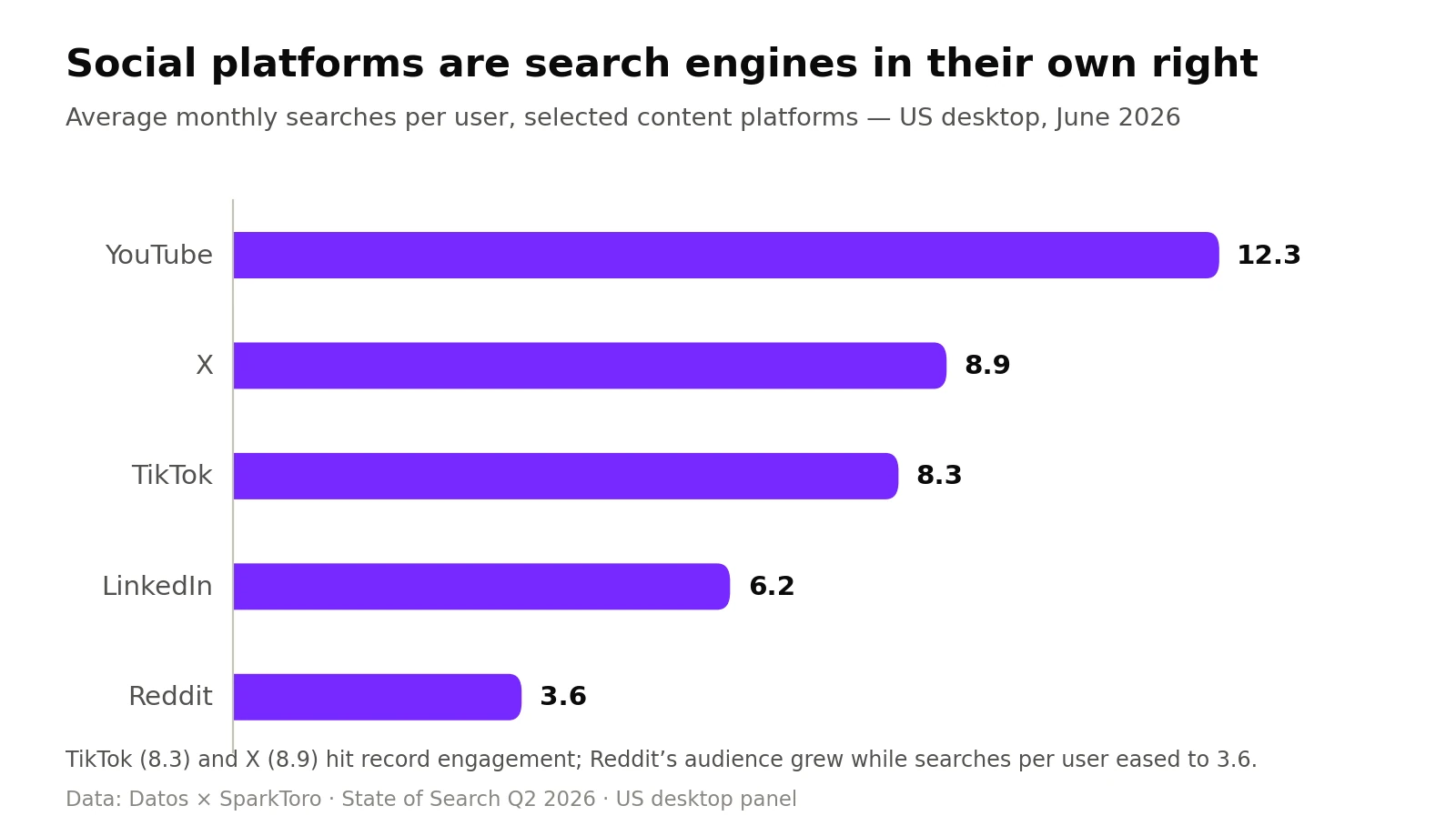
Reddit is the interesting outlier. The share of EU and UK desktop users visiting Reddit grew from 29.4% in April 2025 to 41.6% in June 2026, while searches per user softened to 3.6. More people used Reddit during the month, while the average active user searched slightly less.
This could be because people navigate to their saved communities on Reddit, or just scroll their feed.
The report makes a broader point here though. Growth on these platforms is increasingly coming from engagement as well as audience size. In this desktop panel, reach alone no longer explains how strongly people use these platforms.
The desktop limitation is important to note. The report does not capture the full in-app search behaviour of mobile-first platforms such as TikTok and Snapchat, so these figures are a useful comparison rather than a complete count of social search.
The Organic Journey Has More Stops In It
That platform growth did not coincide with a fall in traditional search share much to the disdain of the pop-up anti-Googlers in this AI era. Traditional search rose from 10.26% of US desktop activity in Q2 2025 to 10.52% in Q2 2026, while AI tools grew from 1.37% to 1.83%. In the EU and UK, traditional search sat higher again at 11.63%.
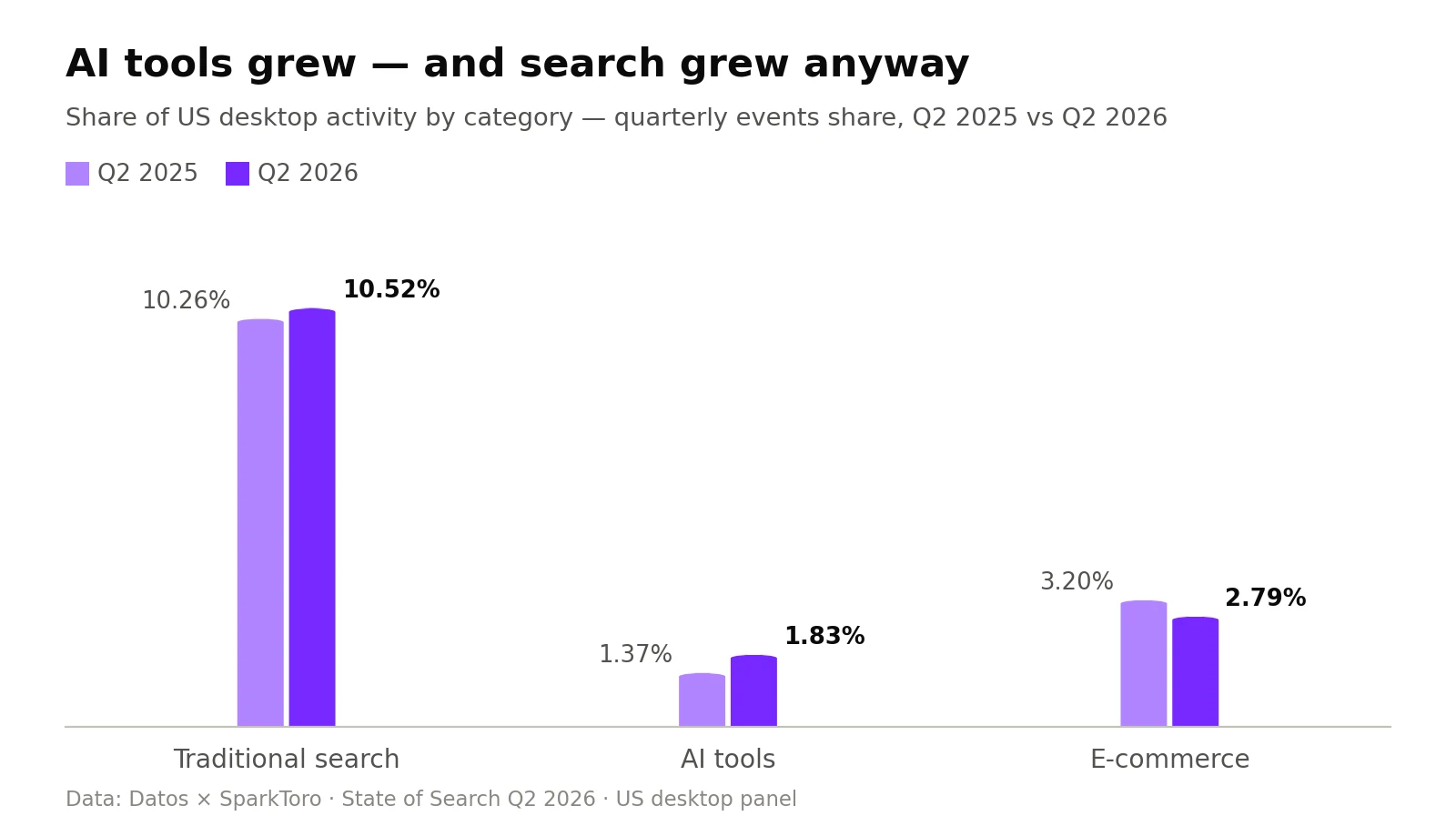
So social search grew, AI grew and traditional search grew too.
That does not prove every user’s journey is longer. But it does show that the zero-sum story is too neat and the post-search destination data gives us a better view of how the surfaces connect.
Two other data points support the augmentation case.
First, intent. Informational queries on Google climbed from 59.69% to 65.12% of US desktop searches year on year, while navigational queries fell from 22.77% to 16.43%. People are using Google to research, not only to find the front door of a website they already know. This pretty much flies in the face of mainstream AI narratives, and to be honest I love to see it. It’s data, not assumptions.
People using Google more for informational queries is not something most people would have had on their 2026 bingo card.
Second, destinations. Look at where people go immediately after a traditional search. YouTube ranks first and Reddit second. Facebook, Instagram, TikTok and LinkedIn also sit inside the top ten. Six of the top ten post-search destinations are social platforms. Google acts as a route into social content as well as a competing discovery surface.
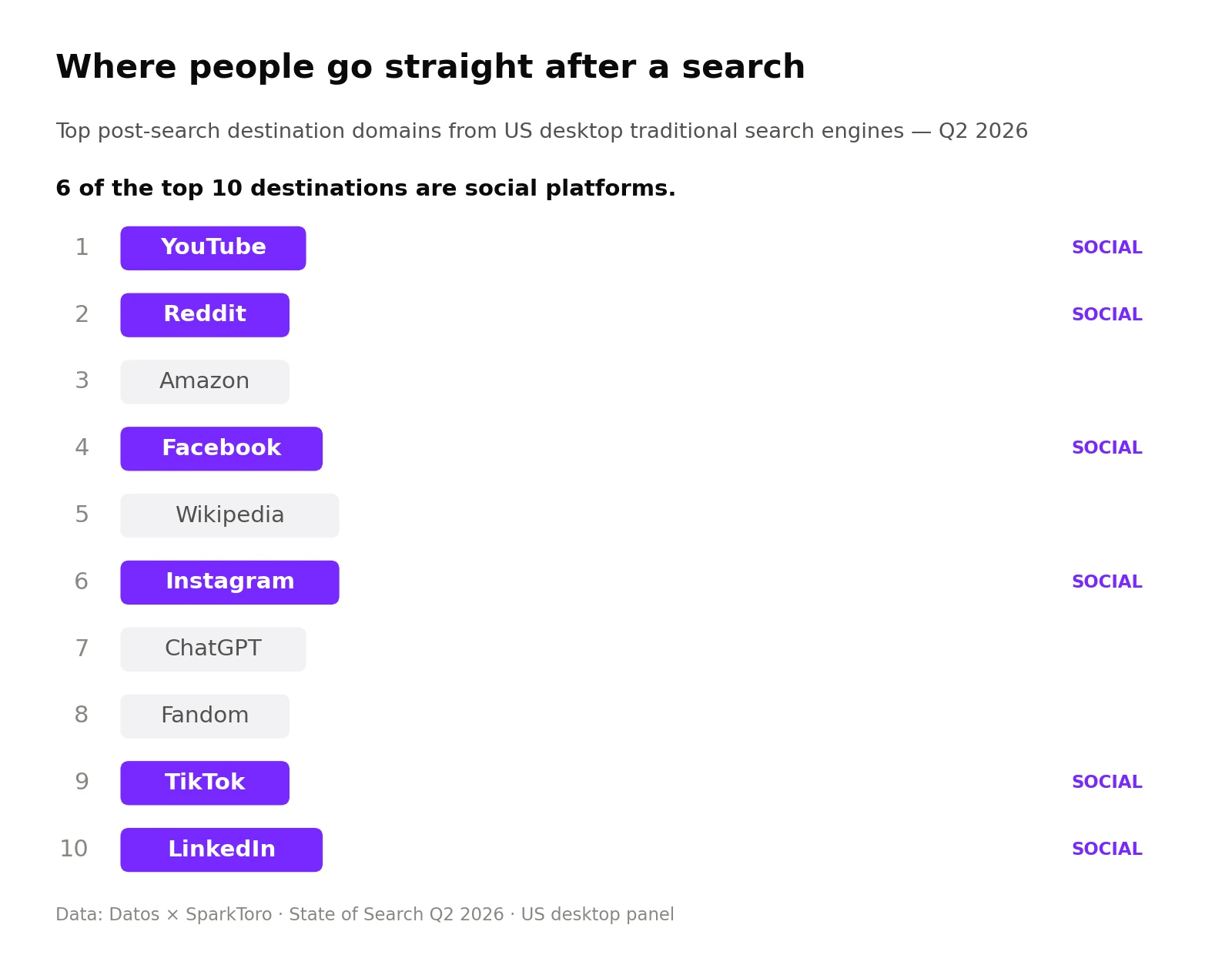
ChatGPT also climbed that destination list from ninth to seventh, making it the biggest upward mover. Search increasingly hands people to other discovery surfaces, not only to websites.
The loop can look like this. Someone searches Google, lands on a Reddit thread or YouTube review, searches TikTok for demonstrations, then returns to Google with a sharper and often branded query. Search can start the research and pick it up again when the person is ready to compare, locate or buy.
That journey though is an analytics black box for businesses. We cannot trace a user and attribute their search adventure in GA4. At least the data tells us this is happening. So that means multi-medium stocks are on the up for brands.
Stories Are the Blind Spot in Social Search Research
Posts, videos and threads persist long enough to be crawled, ranked and cited. Stories are harder to capture because they are short-lived and distributed inside apps. They rarely appear in normal crawl data, ranking tools or standard social listening views.
That creates a research gap. Brands and creators often use Stories to test hooks, share promotion codes and soft-launch offers before the same messaging reaches a feed or landing page. If branded query volume moves after a Story-led campaign, standard web analytics may show the movement without revealing the trigger.
When I research competitors on social search, I keep a shortlist of public brand and creator accounts and log their Stories alongside their paid ads. For TikTok, a TikTok story viewer can capture public Stories from a browser for later comparison. SpyBroski says its tool can view and save them without requiring a login.
Snapchat is harder to inspect from desktop. A Snap story viewer provides a browser-based way to review public Stories where they are available.
Keep the scope to public brand and creator content. The purpose here is to preserve a short-lived creative, message or offers so it can be compared with later search demand and give you more competitive ideation.
It is a bit of a fiddly and detailed thing to do, however imagine this scenario on Black Friday. Offers flying left and right, competing brands dropping snappy stories to support their campaign. A databank of this could be a goldmine.
Which leads me to:
Folding Social Search Into an SEO Program
Treat social discovery as an input to SEO research, content, authority and measurement. That fits the broader reality that SEO metrics are multiplying as discovery spreads across more surfaces.
- Mine TikTok and YouTube search suggestions for the language people use, then feed it into keyword research instead of treating it as a separate channel.
- Track which Reddit threads and YouTube videos rank for commercial terms. Decide whether an owned page, useful contribution or creator partnership can earn genuine visibility. Maybe it’s all 3.
- Review public competitor Stories weekly. Log the hooks, offers, account and date so the observation can be checked later.
- Compare social campaign dates with branded impressions and clicks in Search Console. Treat the movement as correlation until seasonality and other channels have been ruled out.
Comments and replies can tell you what a search suggestion leaves out. Use the questions and problems people share on social media as seed material for keyword research. Keep their wording, then check it against search results, Search Console queries and customer conversations before deciding what to add to the site.
For example, if people repeatedly ask whether a reporting tool includes historical data, check whether the product page answers that question. Add the available date range and any plan restrictions where buyers compare features. A recurring objection can justify a clearer explanation without needing its own blog post.
Social feedback can also help you test an explanation before expanding it. Use customer responses to guide improvements to website content and design. Try a short demonstration or comparison, collect the follow-up questions, then revise the relevant page. Judge the test by what you learnt about customer uncertainty, not just the reaction count.
Share a specific finding, chart or result from a substantial resource with writers and publishers who may use it in their own work. Keep the supporting evidence on an accessible page they can reference. Track referral visits and new editorial links separately from organic search performance.
The same logic sits behind generative engine optimisation. Visibility increasingly depends on being present wherever validation happens, not only on holding one ranking.
I really do believe that for this reason, impressions as a KPI are far more important now than they have been in the past.
The data does not show a one-way migration from Google to TikTok, ChatGPT or any other platform. It shows a connected journey. In the end, the advantage goes to brands that can recognise the same demand as it moves through search results, social platforms and AI answers, then measure what happens next.
Source: Datos × SparkToro, State of Search Q2 2026. US and EU/UK desktop clickstream panels covering April 2025 to June 2026.